Thoughts on the Prayer

|
Wander with me through the verses of the Qur'an's second chapter, Baqarah - through its parables and its admonitions, its remembrances and its legislation. We come upon the verses of divorce, widowhood, and lactation when suddenly we are given a jolting reminder: Hafidhu 'alas-salawati was-salatil-wusta wa qumu lillahi qanitin.

"Guard over the prayers and the middle prayer, and stand before God with obedience" (Q2:238).

And then, we return again to the verses of divorce and widowhood, and we're left amazed as to how the Qur'an went so jarringly off-topic - how the Qur'an interrupted itself so abruptly. It's as though the Book was trying to make a point about the primacy of prayer over all matters.

The Salah, prayer five times a day, has always been a pillar of the Muslim existence, and yet so often we let it pass by us and slip from our fingers while we are unaware. The Salah: it becomes reduced to a mindless construction of oft-repeated statements and rote movements - to the point that we may wonder what just happened between our raising our hands to say Allahu akbar and our final salams. So I wanted to share some random thoughts about the prayer that I've found have benefited me.

Fatihah

No prayer is complete without the recitation of the Qur'an's first chapter, entitled Fatihah, the "Opening." And despite beginning the Qur'an, Fatihah stands apart from it, as though unlike any other part of the Book. The rest of the Qur'an has a specific voice, where God is speaker referring to himself in either the first or third person. The believers' words are still relayed to us, but their statements are often first introduced by quotatives like qalu or commands like qul - "they said" or "say" respectively.

Fatihah, however, was revealed entirely in the voice of the believer, a simply cry to the Lord of the Universe. Here, the reciter begins in God's Name, acknowledging His compassion and universal benevolence. Then she praises God until beseeching the Lord uninhibited, saying Iyyaka na'budu wa iyyaka nasta'in. Ihdinas-siratal-mustaqim.

"Guide us, all of us, upon the straightened path."

So when we compete the recitation of the Seven Verses of Fatihah and continue with some other portion of the Qur'an, we experience that tremendous shifting of voice. While reciting Fatihah, we are speaking, calling out to God; while reciting another portion of the Qur'an, it is God who is the Speaker - speaking back to us and answering our prayer for guidance.

Sami'al-lahu liman hamidah

For the most part, changes in position during the prayer, such as to go into prostration or rise up from sitting, are signified by saying Allahu akbar, "God is greater." The statement is a simple reminder as the worshiper enters each new state, that one's concentration belongs to God alone and no other lesser entity - that God is greater than all that may divert us.

But in rising from bowing, the statement is different: Sami'al-lahu liman hamidah. I've always seen this statement translated "God hears those who praise Him," so when we subsequently respond Rabbana wa lakal-hamd, "And to You, our Lord, is all praise," it has always seemed to me to be an attempt to praise God in order to be heard by Him.

But it struck me that we're technically not saying "God hears those who praise Him." The verbs used in the statement are all in the perfect tense, so a better translation may be "God has heard the one who has praised Him." Here, the praising and God's hearing have already occurred, even before we say Rabbana wa lakal-hamd, which left me wondering which "praising" the statement was actually referring to.

Maybe the statement is actually referencing our recital of Fatihah before going down into bowing, our saying Al-hamdu lillahi rabbil-'alamin. That understanding infused for me new meaning in what we say upon rising from bowing. It is as though we are being informed that God has heard our recitation of Fatihah and the Qur'an, God has heard our calls for guidance towards His path. And to be informed of that should be a matter of great happiness and thankfulness. As we stand up from bowing, knowing that God has heard our calls, how can we not feel a sense of gratitude driving us to praise God all the more?

Rabbana wa lakal-hamd

California Propositions and "Sarah's Law"

|
I recently dedicated a chunk of my afternoon deciding which of the California Propositions to vote for this coming Tuesday. After reading the arguments and rebuttals for and against each proposition, I decided I'll be voting Yes to only three of the twelve propositions, although my opinions could still change in the next two days. Curious as to how my opinions compared with others in the Muslim-American community, I checked the recent MPAC publication, "Activate 08: An Analysis of the California State Propositions," which turned out to be an immensely interesting reflection of the Muslim-American community's precarious political position today and its alienation from the right-wing conservatism associated with the Bush administration. Take, for instance, MPAC's uber-PC tip-toeing around Proposition 8, which would constitutionally define marriage as a heteronormative institution. It seemed to me as though MPAC's indecisiveness on the matter was an attempt to not alienate the Muslim community's liberal allies. I guess that's just how the political game must be played nowadays, huh?

Another one of MPAC's indecisions concerned Proposition 4, which I had already decided to vote against. Entitled "Sarah's Law," Prop 4 would call for a "waiting period and parental notification before termination of a minor's pregnancy." Both sides of the issue argue that they would be protecting the girls involved. Proponents are arguing that a law would prevent girls from getting abortions against their will, especially if forced to do so by the men who may have raped and manipulated them. Opponents argue that mandating that parents are informed about their daughter's decisions would force many towards unsafe, underground procedures in desperation.

The proposition isn't about the issue of abortion itself, but I'll digress a bit to talk about abortion because it's something that American faith-based groups have found themselves quite polarized over. My sense is that the discussion of abortion hasn't played out so strongly Muslim-American community, and this maybe because of apathy or alienation from those segments of the Christian population who are strongly opposed to abortion. But the silence may also be due to juristic allowances for abortion based upon some statements attributed to the Messenger. Islamic scholars have pointed out that the "ensoulment" of the embryo does not occur at conception as Christians may postulate, but rather occurs after a period of 40 or 120 days. This has led some scholars to deem abortion before the "ensoulment" to be permissible, although reprehensible.

Still, I feel there's a general uneasiness in the Muslim community over abortion, but this uneasiness may have less to do with the Islamic prohibition of killing one's children and far more to do with a fear that abortion would lead to a greater freedom of sexuality in society. "Allowing even juristicly permissible abortion," the argument goes, "would lead to greater sinfulness in society because sexuality would not have consequences." And to prevent such loose sexuality, some may advocate banning or extremely restricting abortion along with other juristicly permissible things like condoms, birth control, or even vaccines against sexually transmitted diseases. Society's health and psychological consequences from these actions would simply be brushed aside as a due God-given punishment for enjoying forbidden sexuality. This fear, in my opinion, can cause far more harm than good, driving the existence of sexuality's undesired consequences underground and placing a heavy social stigma on the very people who, after making mistakes, may need the most help.

(By the way, I recently watched a troubling film, Four Months, Three Weeks, and Two Days, set in Communist Romania where abortions had been banned under Ceauşescu. That didn't stop desperate girls looking to manipulative men for underground abortions. And if medical problems from these abortions were to arise, where could these girls turn? Not to the hospitals run by a government that would promptly incarcerate them as criminals.)

Back to Proposition 4. The arguments in favor of the proposition are very emotional, arguing that there are girls who are forced to have abortions under the pressure of the men who have manipulated them. Under the current California laws, such abortions can take place without parental notification, and proponents argue that these child predators could continue to prey on young girls without anyone "having to know." Although this is a problem, I can't see Proposition 4 doing anything to adequately solve it. The predators who do take advantage of girls could easily manipulate those girls into protecting their identity even when parents are informed. Or they may place a greater pressure on the girls to turn towards unsafe underground abortions. All the while, the law may harm those many girls who don't have supportive households and who may go through considerable emotional distress if their parents were involved.

I believe the arguments of those in favor of Proposition 4 would be better addressed with laws that require medical professionals to be more in tune with the possibility of child-abuse and create a safe medical environment where girls can seek confidential help (not that I'm saying that many of those laws and structures don't exist already). In Prop 4, however, I see a thinly disguised attempt to portray medical professionals who perform abortions as dangerous practitioners. Furthermore, in attempting to place greater impediments for girls in obtaining an abortion and limiting its availability, "Sarah's Law" seems to be an effort born out of a society's fear of sexuality where we would rather maintain the undesirable societal consequences of sexuality than risk letting people "get away with it."

Stoning Aisha

|
The word perversion is an understatement here. Amnesty International recently reported that a thirteen year-old girl was stoned to death in Somalia, accused of adultery. Amnesty reports that sources claim she was raped by three men and that she attempted to inform the authorities who saw fit to charge her for violating Islamic law.

Aisha Ibrahim Duhulow was accused of adultery, but sources told Amnesty International that she had in fact been raped by three men, and had attempted to report this rape to the al-Shabab militia who control Kismayo. It was this act that resulted in her being accused of adultery and detained. None of men she accused of rape were arrested.

Shari'ah in practice? The case of Aisha Ibrahim Duhulow and the Saudi girl from Qatif earlier this year all too painfully bring to light the injustices across the Muslim world arising from the attempted implementation of Islamic law. Maybe the masses are fooled due to ignorance of the Qur'an or the true Prophetic Paradigm. Or maybe people have been trained to deem anything that opposes the West and its liberalism as a valid Islamic alternative. Have we come to accept any harsh and unpalatable corporal punishment as a true manifestation of God's will? And have we become silent to injustice in our communities fearing that we may be questioning God's mysterious wisdom?

So a girl was murdered for a crime in which no four witnesses testified against her. In 2005, Tariq Ramadan made a strong point in calling for a moratorium on corporal punishment in the Islamic world, earning the antagonism of many. But when our laws and punishments blatantly target the weakest segments of our society - women, ethnic minorities, and the poor - this shari'ah we cling to uphold is far from a "well-trodden path" towards God but rather a path to our own self-destruction.

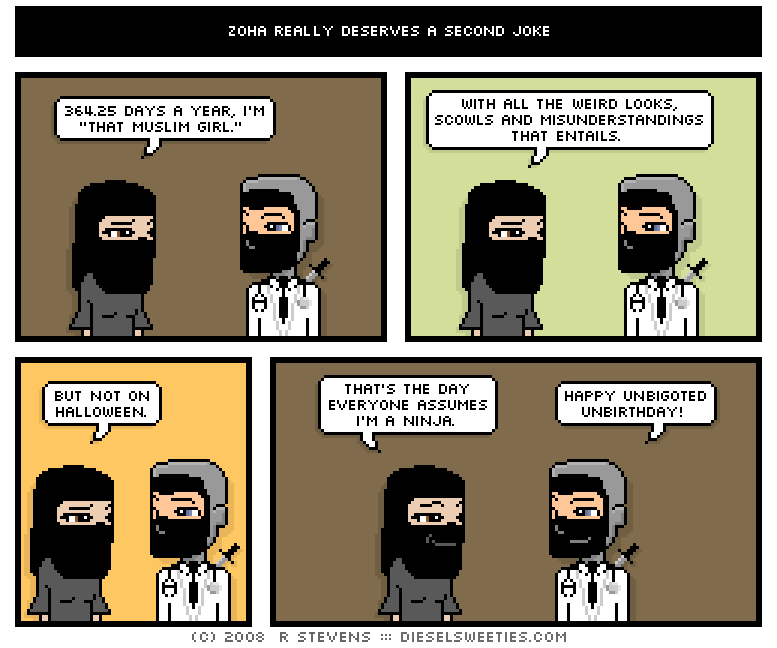
Muslims in Halloween

|

Our Fight

|
Muslim Convert Sets Off Bomb

There was a time in Muslim history when a Muslim leader sent a warring general his doctor when he heard of him being ill, and now where are we? It seems now there are Muslims that are ok with convincing mentally challenged people to blow up families with their children at dinnertime. These are the cowards, the filth that ruin al our efforts as peaceful, tolerant Muslims. So let me ask you this? Isn’t it possible that we have greater problems to discuss than Zionists? When an Israeli soldier shoots a boy and his father who are innocent bystanders, it is nothing less than a horrific act, a horrible act that directly affects two people. But when a spineless Muslim cleric “recruits” a mentally challenged youth to hurt innocent people, it affects 1.6 Billion Muslims directly. Because this is how we are now seen, as people who are soulless and horribly misguided by our religion. There is an important fight going on in our world today, and it is not a fight against any race, religion or political belief, it is a fight against ignorance. When Muslims in Britain are ignorant enough to let this happen, it hurts each and every one of us. Therefore when we go and organize a Justice in Palestine week to show people the plight of the Palestinians, it is completely useless, we have absolutely zero credibility left to stand on. When one day it’s a handicapped boy in Britain and the next its mentally challenged suicide bombers in Iraq and the next is little children with explosives, how do we expect to stand up before the people of the world who hear and see these crimes against humanity and tell them about how we are suffering in other parts of the world, or how we are being oppressed in a country on the other side of the globe. There is a duty for each and every one of us to fight against the Muslims who are raping our religion and our integrity. But this is not a fight fought with weaponry, organization or bloodshed, far from that it is a fight fought with kindness. Now I know this will start to sound like hippie crap right now but it’s necessary for a fight we are losing. When we go out into the cities we live in we must shower everyone we meet with kindness, and love, I once heard a Christian priest tell his followers “treat everyone you meet as if they were going to die at midnight.” This is powerful and effective, because people’s personal experience with you and your kindness, your going out of your way for them, your selflessness and your courage will ring louder in their hearts than a clerics attempt at killing people ever will.

Islam, the Solution?

|
It was interesting to see the vibrancy of the Muslim Brotherhood during the Egyptian elections a few years ago. With the strength of religious revival on the banks of the Nile, the organization, despite the impediments it faced as an illegal party, significantly increased its presence in the parliament. But what troubled me throughout the election was the Brotherhood's use of sloganeering - for instance, one often heard the statement, "Islam huwa-l-hal" or "Islam is the Solution." We may agree with such a statement on principal, but a question still remains: What exactly does that mean?

I remember one Brotherhood-affiliated politician making the claim, "If Islam were truly applied, we would have no hunger." Will the true application of Islam usher in a new utopia - freedom from hunger, poverty, loss, and fear? Will God stop testing those who believe?

The answer is clearly no, as God has promised, "We will surely test you with something of fear and hunger, and loss of wealth, life, and fruits" (Q2:155). The problem with sloganeering is that the society is often given a false expectation of what Islamic-based rule will look like, something that Islamic movements may not be able to deliver once in power. In fact, Islamic movements, long prevented from political power by dictatorial rule, may often find themselves extremely unprepared to deal with actual issues once in power, lacking the necessary practical insight. Slogans may help in winning an election, but they won't keep a government running.

That's why I see the current antagonism from Turkey's secular establishment as a good thing for the Turkish Islamic movement. Despite being democratically elected, the religious-based Justice and Development Party (Turkish: Adalet ve Kalkınma Partisi or AKP) has only narrowly escaped being banned by secularists, yet such fears continue and the party must tread very carefully. Its recent attempt to allow women to wear headscarves in universities and government offices has been overturned as subversive to Turkey's secular constitution. These issues may seem unfortunate to some, but in reality, they require the AKP to be responsive to the needs of the entire spectrum of Turkish society and to actually establish sound social and economic policies. Furthermore, the AKP may become an example of how Islam could be gradually established in a society without the use of force and unjust imposition.

Take the response of one Turkish pro-headscarf activist, Hilal Kaplan, when asked about homosexuality (see hyperlinked article above):

“Islam tells us to fight this urge,” but she said that did not affect a homosexual’s rights as a citizen. “I am against police oppression of homosexuals. I am against a worldview that diminishes us to our scarves and homosexuals to the bedroom.”

I fully agree with that sentiment, but I wonder if that understanding could have come about in a society where one segment of the population quickly and myopically imposes religious doctrine on everyone else. The Qur'an states, "And if God did not check one group of people with another, the earth would have been corrupted, but God is full of bounty for everything" (Q2:251). Some may consider the checks to power that Islamic movements confront as undesired impediments, but in reality, these checks transform slogans like "Islam is the Solution" into concrete realities. These checks are a blessing - forcing Muslims to rise above ethnic and cultural aspects of our identity so that we can reflect on what we truly believe and what we're really fighting for.

Claiming the Deceased

|

"Hindu-Muslim Family's Choice of Cremation Arouses Anger" - Anne Barnard


"The cremation dispute goes to the heart of a debate among Muslims in America about what makes someone a Muslim – to some of the critics, the fact that Shafayet Reja listed Islam as his religion on Facebook is enough."


In an era scarred by takfirist militancy, the question of what makes somebody a Muslim is a very salient one. For some people, a Muslim would be known by a defined set of outward marks – hijab, a beard and kufi, or even the position of one's hands in prayer. The article above reveals an opposite trend, in which a mere declaration of one's religious faith on Facebook is sufficient. The author precisely identified the real dispute at hand – not cremation itself, but the tug-of-war of religious identity that cremation and burial represent.


Conflicts like these where groups vie to claim souls – even deceased bodies – into their fold have a curious tendency to escalate beyond expectation. It’s interesting that although the author relates that the initial contention came from a "small group of Muslims," the dispute sprung from the New York-based Bengali newspapers to make national news in Bangladesh. From what I've seen, mixed Hindu-Muslim marriages like that of the Rejas are generally looked down upon by both Bengali Muslims and Hindus, and such families find themselves alienated to a degree from both communities. In the eyes of many from the Muslim community, Shafayet Reja's growing acceptance of his Muslim identity may have been seen as a victory over the secular society that allows such mixed marriages to occur – and his cremation, an unfortunate setback.


What rites were to be done with Reja's body could only be his family's choice – if the Muslim community had an issue with cremation, its only recourse could have been calm persuasion. The fact that he was cremated is nothing to grieve over, though, and scattered ashes won't make it any harder for God to resurrect anybody on the Day of Gathering. And as for the question of whether Facebook identity is enough to know if someone is a Muslim – I would say resoundingly yes. The Messenger's Paradigm, his Sunnah, is replete with examples that a legal definition of who is Muslim hinges on one basic, outward statement: “that there is no god but God, and Muhammad is God’s slave and messenger.”